


Presented by ClickUp

Replace scattered apps and endless status meetings with ClickUp.
Tasks, subtasks & priorities for clear ownership.
Docs & wikis that live alongside your work.
Built-in time tracking - no third-party tools needed.
ClickUp AI writes updates, summarizes threads, and removes blockers.
1,000+ integrations including Slack, Notion, and Google Drive.
Try ClickUp free - no credit card required and reclaim your team's time today.

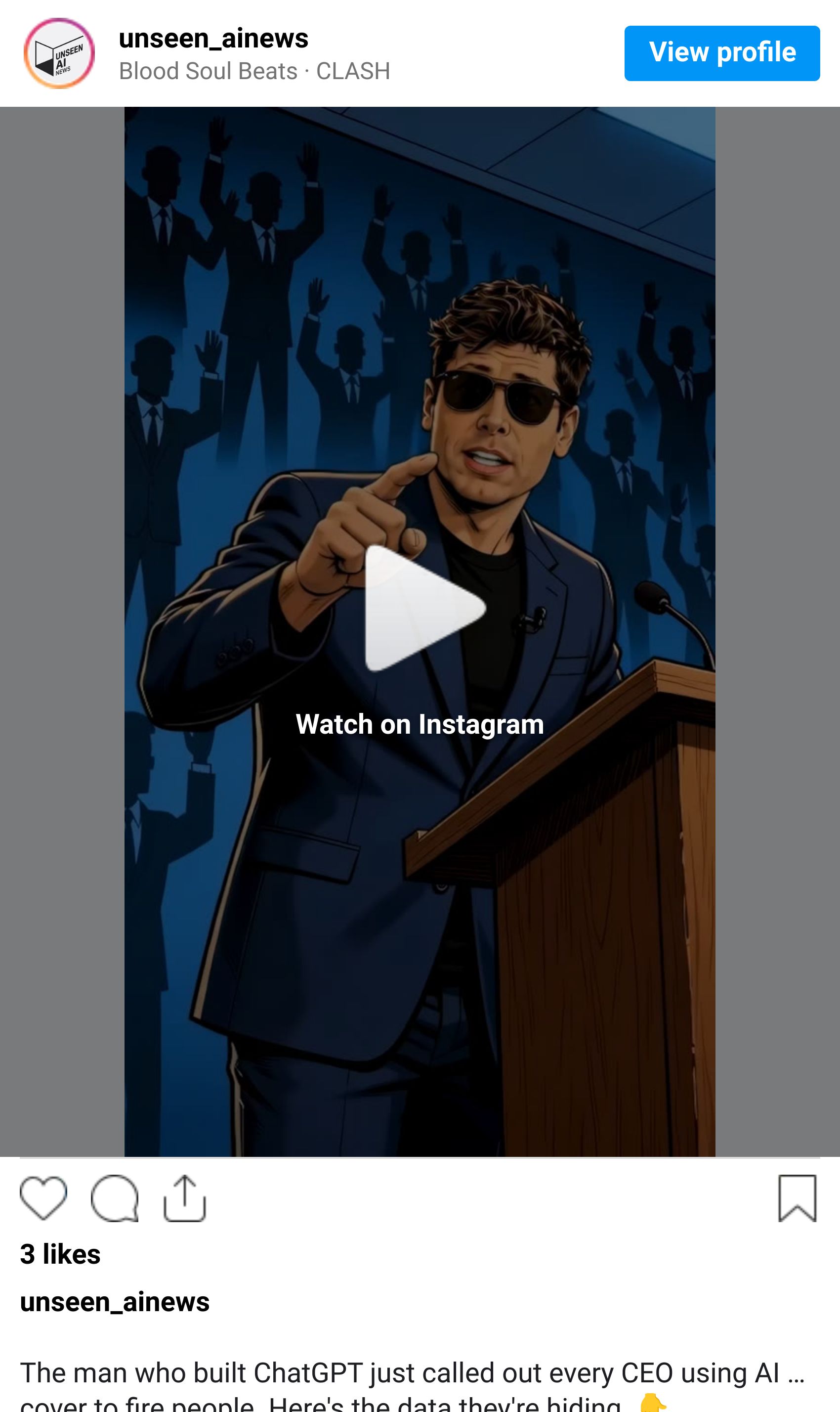
The hottest line in AI this week did not come from a product launch, a benchmark chart, or a trillion-dollar forecast. It came from OpenAI CEO Sam Altman, who said some companies are blaming AI for layoffs they would have made anyway.
In one stroke, he put a name on the narrative game founders, employees, and investors have all been sensing: AI washing.
“I don't know what the exact percentage is, but there's some AI washing where people are blaming AI for layoffs they would otherwise do. And then there's some real displacement by AI of different kinds of jobs.”
That one sentence matters because it gives founders permission to tell the truth again. Not the performative truth. Not the investor-deck truth. The real one. Sometimes a company cuts because demand slowed.
Sometimes it cuts because it overhired. Sometimes it cuts because it built too much management, too many meetings, too much process, and too little product. And yes, sometimes AI is genuinely replacing pieces of work.
But right now, the market is mushing all of that together into one irresistible headline. That is dangerous for teams, dangerous for strategy, and dangerous for any startup founder tempted to confuse a better story with a better business.
There is another hidden layer here. In the same interview, Altman said India is OpenAI’s second-largest market and that ChatGPT has more than 100 million weekly active users.
Translation: AI demand is exploding, but the labor narrative around AI is still sloppy, politicized, and in many cases unproven. The opportunity for founders is not just to adopt AI. It is to communicate AI with surgical credibility while everybody else is still shouting.

The Fact-Check Ledger: What We Can Prove, What We Cannot
7,624
January 2026 U.S. job cuts explicitly citing AI
Challenger, Gray & Christmas reported 108,435 total announced U.S. job cuts in January 2026, with AI cited in 7,624 of them, or about 7% of that month’s total.
54,836
Layoff plans citing AI in 2025
The same Challenger report says companies referenced AI for 54,836 announced layoff plans in 2025, and 79,449 announced cuts since 2023, when it first began tracking AI as a reason.
95,667
U.S.-based tech layoffs in 2024
Crunchbase News says at least 95,667 workers at U.S.-based tech companies lost their jobs in 2024. It also says around 127,000 were laid off in 2025. Crucially, Crunchbase calls these numbers best estimates, compiled from media reports, its own reporting, social posts, and layoffs.fyi.
Here is the founder-level interpretation: the public conversation is acting like the AI-layoff case is already closed. It is not. We do have evidence that companies are citing AI in layoff announcements.
We do not have broad public proof showing what share of those cuts were truly caused by AI versus restructuring, contract loss, weak demand, or post-boom cleanup. That distinction is the whole story.
The Snippet That Should Hit Every Founder in the Chest
This is the twist. Altman is not saying AI displacement is fake. He is saying the story is being told too early, too loosely, and sometimes too conveniently. For founders, that means two realities can be true at once.
Some companies are absolutely using AI as a narrative shield for cuts that were coming anyway.
At the same time, authentic labor displacement from AI is still coming harder, faster, and more visibly.
That is a brutal combination. It means mediocre operators can look visionary for a quarter simply by talking louder about AI. It also means disciplined operators can quietly build monstrous advantage while the market is still mesmerized by the headline theater.
For a startup owner, the implication is electric: the edge is no longer “Do we use AI?” The edge is “Can we show exactly what AI changed in our economics, team design, customer experience, and shipping velocity without resorting to vapor?”
The founders who answer that cleanly will sound like adults in a room full of costume futurists.
What the Data Actually Says About Layoffs, Right Now

If you want to cut through the fog, start with what is counted. Challenger reported that U.S.-based employers announced 108,435 job cuts in January 2026. Of those, 30,784 were attributed to contract loss, 28,392 to market and economic conditions, 20,044 to restructuring, 12,738 to closings, and 7,624 to AI.
That does not mean AI is irrelevant. It means the current layoff wave still has multiple engines, and AI is only one of them in the public tally.
It’s difficult to say how big an impact AI is having on layoffs specifically… the market appears to be rewarding companies that mention it.”
That line should ring in every startup founder’s ears. If markets reward AI language, then incentives exist for companies to overstate AI’s role. And whenever incentives and narratives align, the founder’s job is to ask the one question everyone else avoids: what changed operationally, exactly?
Meanwhile, Crunchbase says at least 95,667 workers at U.S.-based tech companies lost jobs in 2024, and roughly 127,000 were cut in 2025.
But Crunchbase also warns that these are best estimates, not pristine census-quality counts. That caveat matters. Responsible founders do not launder estimates into certainty. They keep the uncertainty visible.
Presented by Semrush

Struggling to understand why your competitors rank higher or where your next customers will come from?
Use Semrush - the powerful platform that brings clarity to your entire digital marketing strategy.
Keyword & topic research to target the right audience
Comprehensive site audits to identify and fix SEO issues
Backlink analysis with valuable link-building opportunities
Content optimization tools to boost rankings and engagement
Advertising & PPC insights to maximize campaign performance
Big Picture: Why Founders Still Can’t Afford to Be Casual About AI
Projection: 22% Jobs projected to be disrupted by 2030
The World Economic Forum says job disruption could affect 22% of jobs by 2030, with 170 million new roles created and 92 million displaced, for a net gain of 78 million jobs.
Projection: 41% Employers planning workforce reduction due to AI
The same WEF release says 41% of employers plan to reduce workforce size where AI can automate tasks, while 77% plan to upskill workers and nearly half expect to redeploy staff into other roles.
Estimate: $2.6T–$4.4T Annual value across 63 gen-AI use cases
McKinsey estimates generative AI could add the equivalent of $2.6 trillion to $4.4 trillion annually across 63 use cases.
Estimate 75% Value concentrated in four functions
McKinsey says about 75% of that value sits in customer operations, marketing and sales, software engineering, and R&D. That is not random. Those are exactly the functions where lean startups can compound advantage fast.
So yes, the hype is messy. Yes, some layoffs may be getting dressed up as AI transformation. But the long-game opportunity is still enormous.
That is the paradox of this moment: short-term narratives are noisy, but long-term leverage is very real. Founders who can hold both ideas at the same time will outbuild people who can only think in slogans.
🚀 The Founder Take: What This Means if You Run a Small Startup
First: do not use AI as a theater prop. If your business cut costs because growth cooled or because you hired too fast, say that. Teams forgive hard truth faster than polished spin. Once employees suspect the AI story is cover for management mistakes, you lose the one asset AI cannot print: trust.
Second: stop treating headcount reduction as the default proof of AI sophistication. The best founders are not asking, “How many people can AI replace?” They are asking, “How much more output per person can we unlock without breaking culture, quality, or speed?” That question creates healthier products, better retention, and more resilient margins.
Third: build an evidence trail. If AI reduced support backlog by 32%, improved outbound personalization, cut engineering cycle time, or saved founders ten hours a week on repetitive work, document it. The startups that win the next financing cycle may not be the most “AI-native” on paper. They may simply be the most legible.
The Questions Smart Founders Should Ask Before They Ever Say “AI Made Us Leaner”
What work changed? Name the workflow, not the vibe.
What metric improved? Time saved, revenue lifted, defects reduced, response times shortened, conversion increased.
Who was redeployed? If people were freed up, what higher-value work are they doing now?
What did not improve? Serious operators publish the limit cases too.
Can an outsider audit this claim? If not, tone it down.
That last one is lethal. Most startup AI claims fail not because they are fully false, but because they are impossible to inspect. Investors increasingly know the difference. Senior talent knows the difference. Your customers will know the difference next.
The Bottom Line
Sam Altman did not merely criticize a few bad headlines. He exposed a deeper market tell: some companies want the valuation bump of sounding AI-native without doing the hard operational work of becoming AI-native. That gap is where startup opportunity lives.
If you are an entrepreneur reading this, do not just ask whether AI will kill jobs. Ask a sharper question: who is using AI to become undeniably better, and who is using AI to make old problems sound futuristic? One group is building the next decade. The other is just rewriting the press release.
The future will belong to founders who can prove leverage without faking inevitability.
📧 Forward this to 3 entrepreneur friends who need to see this opportunity


